05.08.2026Open Position MEP/BEP
Open position MEP: Cryogenic fabrication of Josephson junctions for superconducting quantum processors
Quantum computing has potential to solve certain computational problems that lie beyond the capabilities of classical computers. Among hardware platforms, superconducting quantum circuits are promising candidates for realizing large-scale, fault-tolerant quantum computers. A key component of these circuits is the Josephson junction (JJ), whose fabrication affects the accuracy and precision of qubit frequency targeting.
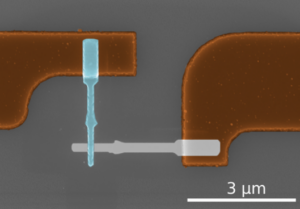
Conventional superconductor-insulator-superconductor Josephson junctions (JJs) are fabricated using electron-beam evaporation of aluminum (Al) at room temperature [1]. This project will investigate an alternative approach in which the substrate is cooled to 77 K using liquid nitrogen during Al evaporation. Previous studies have shown that cooling the substrate to liquid nitrogen temperature during the evaporation modifies Al grain structure, reduces surface roughness, and alters superconducting properties of the deposited films [2]. However, its impact on JJ fabrication yield, reproducibility, and superconducting qubit performance has not yet been systematically studied.
We are looking for a motivated Master’s student with keen interest in nanofabrication and quantum hardware to explore cryogenic fabrication of Josephson junctions!
Project description
- Design JJ test devices using Python.
- Develop fabrication process in cleanroom for reliable cryogenic JJ fabrication.
- Characterize fabricated JJs using conductance measurements and metrology techniques to study grain structure and deposition-related effects, such as the so-called ‘halo’ effect.
- Study the yield and conductance spread of JJs and compare to conventionally fabricated JJs.
- Investigate laser annealing effects (post-fabrication conductance trimming method [4]) on cryogenically fabricated JJs and compare to conventionally fabricated JJs.
- Finally, fabricate a multi-qubit superconducting processor to evaluate frequency targeting and the impact of the cryogenic JJ fabrication process on qubit coherence.
Prerequisite
For this MEP, you are required to have taken (and passed) the MSc course AP3222 Nanotechnology (taught by S. Goswami and R. Norte).
If you are interested in this project and would like to learn more, please contact Kishore Kumar Thiyagarajan (K.K.Thiyagarajan@tudelft.nl, daily supervisor).
To gain further insight into the research at DiCarlo lab, please visit https://qutech.nl/lab/dicarlo-lab-welcome/
References
- Osman et al., Applied Physics Letters 118, 064002 (2021).
- A. Tarasov et al., Technical Physics Letters 51, 95 (2025).
- R. Di Carlo, M. Samiotis et al., ArXiv:2602.18388 (2026).
- Valles-Sanclemente, S.L.M. van der Meer et al., Applied Physics Letters 123, 034004 (2023).